
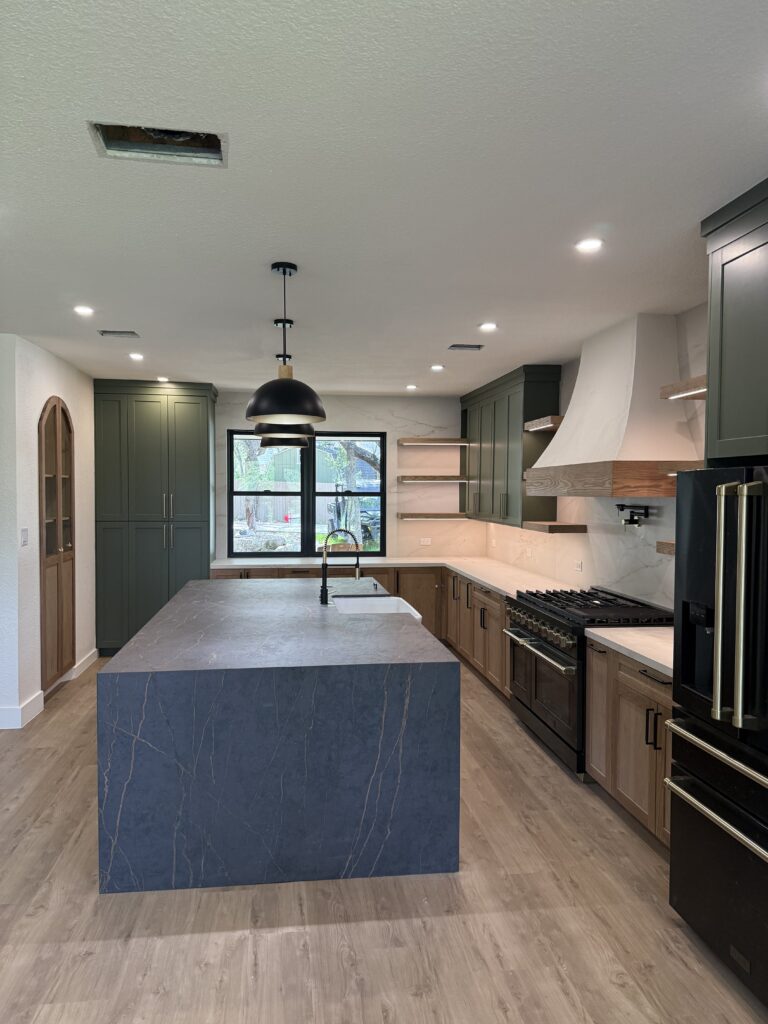
Three proposals for the same kitchen. The first is a single number on letterhead. The second runs four pages of line items with an hourly rate at the bottom. The third says fixed price in bold across the top — then, halfway down, lists six allowances.
All three are quoting the same room. Only one of them is telling you what it will cost, and it isn't necessarily the one with "fixed price" printed on it.
The phrase sounds like it should be self-explanatory. It isn't. A fixed price only means something once you know what it's fixed to — and that answer lives in the paperwork behind the number, not the number itself.
What the Price Is Actually Fixed To
A fixed-price contract — lump-sum or stipulated-sum, if you see those terms — commits a contractor to finishing a defined scope of work for a defined dollar amount. Labor runs long, lumber jumps, a subcontractor misquotes: that's the builder's problem now. Transferring that risk is the entire point of the structure.
Which puts all the weight on two words: defined scope. A price attached to a paragraph of description is a guess wearing a suit. A price attached to dimensioned drawings, elevations, a written specification and a finish schedule is something you can hold someone to.

Which is why sequence matters more than almost anything else in this conversation. Quote a firm number in the first meeting and you're pricing an idea. Quote after the plans are drawn, the selections scoped and the existing conditions documented, and you're pricing a project.
A price attached to a paragraph of description is a guess wearing a suit.
What's inside the number
A well-prepared fixed price generally accounts for labor across every trade in scope, materials and fixtures at the specified finish level, subcontractor bids drawn from the plans, project management, permitting and administration, overhead, and a contingency the builder carries internally for reasonable variation.
You won't usually see that breakdown itemized, and that's normal — it's the builder's arithmetic, not yours. What you should see is enough specification detail to know exactly what you're buying.


Three Ways to Buy a Remodel
Nearly every remodeling agreement is one of three structures, and each one parks the risk somewhere different.
Fixed price. The number is known before work starts, and overruns inside the agreed scope belong to the contractor. Predictable to budget against. The tradeoff is front-loaded: nobody can quote it responsibly without doing the design work first.
Cost-plus. Actual costs, plus a percentage or a flat fee. You see the invoices, which is genuinely transparent — but you don't know the total until the job ends. It earns its place where scope truly can't be pinned down, like extensive structural repair in an older home.
Time and materials. Hours worked plus materials used, usually without a ceiling. Sensible for a small repair. Difficult to live with across a full remodel.
None of these is automatically better. Fixed price is simply the right instrument when scope can be defined thoroughly enough to price — which, for most kitchen remodels, bathroom remodels and planned additions, it can be.
Where the Number Can Still Move
Three things sit outside the fixed figure. None of them is a trick, but all three surprise homeowners who didn't know to look.
Allowances
An allowance is a placeholder for something you haven't chosen yet — tile, fixtures, lighting, countertops. The contract sets aside a figure. You then fall for a tile at three times that figure, and the difference lands on your total. Nothing improper happened. The allowance was never a commitment to a product; it was a commitment to a budget line.
Allowances cause more "but I thought this was fixed price" conversations than everything else combined. The remedy is unglamorous and completely effective: make as many selections as you can before the price is set. The fewer allowances in the agreement, the closer your fixed price sits to your final price.

Change orders
The price is fixed to the scope you approved — so add a window, move a wall or upgrade cabinetry after signing, and the number moves. It should. What matters is the mechanism: every change documented, priced and approved in writing before the work happens. A contractor who's casual about that process is telling you something.
Unforeseen conditions
Open a wall in an existing home and you occasionally find what nobody could have seen from a walkthrough — failed plumbing, earlier work done badly, a structural surprise. Most fixed-price contracts carve these out, because pricing an unknown isn't possible. The test isn't whether the carve-out exists. It's whether the contract spells out how such conditions get evaluated and priced when they appear.

Six Questions Worth Asking Before You Sign
These separate a real fixed price from a round number someone arrived at quickly.
- What drawings and specifications is this price attached to? Ask to see the exact set it references — not a description of it.
- How many allowances are in here, and at what figures? Then ask whether those reflect the finish level you've actually been discussing.
- What's explicitly excluded? Exclusions aren't the red flag. Vague exclusions are.
- How are change orders handled? Documented, priced and approved in advance is the answer you want to hear.
- What is the payment schedule tied to? Milestones and progress age better than calendar dates.
- What happens if something unexpected turns up? You want a defined process, not a shrug.
Six clear answers means you're looking at a price someone did real work to produce.
What This Means for an Austin Remodel
A mid-century ranch, a 1990s suburban build and a recent infill house hide three completely different situations behind the drywall. Austin's housing stock is varied enough that rules of thumb break down fast — which is exactly why documentation carries more weight here than any per-square-foot figure you'll read online.
It changes how you should compare bids, too. Two proposals for "a kitchen remodel" can land far apart simply because one carries cabinetry at a different level, or includes electrical the other quietly left out. Comparing totals without comparing specifications tells you almost nothing. Ask each contractor what their number is attached to — then compare those documents.
How We Arrive at the Number
Our process is built so the price comes after the thinking rather than ahead of it. It opens with a conversation about what you're trying to accomplish, then an in-home consultation to walk the space and talk honestly about budget. Design and planning documents existing conditions and develops plans around how the house needs to function — layout, flow and scope settled before anyone talks about finishes.
Those plans become architectural drawings, elevations, permit-ready documents and 3D renderings. You see the project clearly while changes are still cheap. Only then do we present a fixed-price construction agreement covering approved scope, specifications, drawings, payment schedule, timeline and final construction budget.
From there the selection phase locks in materials, finishes, fixtures, cabinetry, hardware, tile and lighting while our team handles ordering and preconstruction coordination. A project manager runs construction against the approved plans. The project closes with a final walkthrough and punch list review.
The sequence is the safeguard. Design first, document thoroughly, then price — which is what makes a fixed number worth trusting in the first place.
Scope of services varies by project; specific deliverables are confirmed during consultation.